 By
·
6 minute read
By
·
6 minute read
Most warehouse safety programmes are built on a rational assumption: if you install the right controls, workers will use them correctly. Put up a sign, paint a line, bolt in a barrier. Job done.
The problem is that assumption isn't really how people work. And if you've done everything by the book and still had near-misses, that gap between what you designed and what happens on the floor is exactly why.
Warehouse safety has long been treated as an engineering problem. Fix the environment, and you fix the risk. But decades of incident data, and a growing body of occupational psychology research, tell a different story. Human behaviour, how people think, where they look, how they move, and how they make split-second decisions under cognitive load, is the variable that engineering alone cannot account for.
In this article, we'll walk through the behavioural science behind how people navigate warehouse environments: the gap between predicted and actual movement, the psychology of visual cues, the risk hidden in moments of hesitation, and what it means for the way you design, segregate, and manage your site.
Contents
- Why Do Workers Ignore Safety Controls They Can Clearly See?
- What Is the Gap Between Predicted and Actual Behaviour?
- How Does Hesitation Create Incident Risk?
- What Do Real Movement Patterns Tell Us About Warehouse Layout?
- What Makes a Visual Cue Actually Work?
- How Do You Design a Warehouse That Works With Human Behaviour?
Why Do Workers Ignore Safety Controls They Can Clearly See?
This is the question that frustrates most warehouse and facilities managers, so it's the right one to start with.
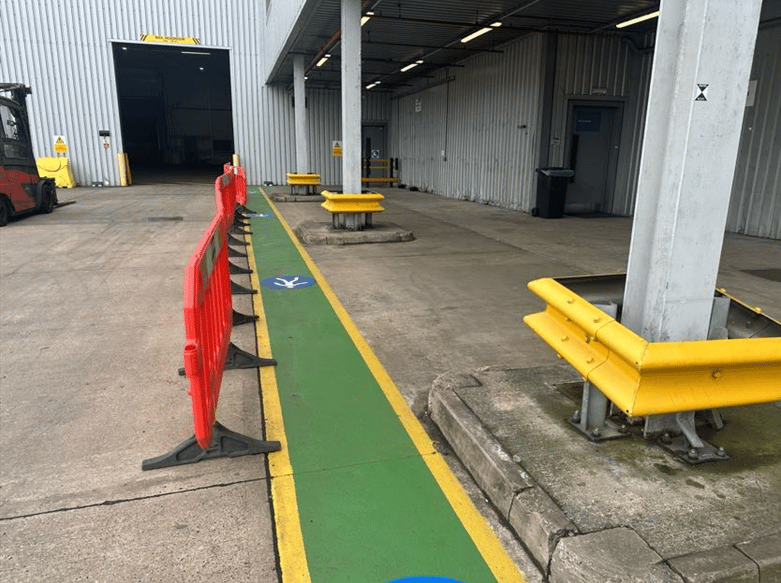
The answer is habituation. The human brain is remarkably efficient at filtering out information that it has processed many times before. A warning sign you pass fifty times a day stops registering as a warning. A painted floor line you cross without incident every shift stops reading as a boundary. The brain reclassifies it as background noise and stops allocating conscious attention to it.
This isn't inattention or poor attitude. It's normal neurology. And it has real consequences in environments where the physical cues used to communicate risk are largely static.
There's a related factor: cognitive load. Warehouse workers are tracking multiple demands simultaneously - picking targets, vehicle positions, colleagues, time pressure. In high-load conditions, the brain prioritises task completion over environmental monitoring. Studies in occupational psychology consistently show that under elevated workload, attention narrows and peripheral safety cues are more likely to be missed.
This is why the Management of Health and Safety at Work Regulations 1999 require risk assessments to be based on how work is actually carried out, and not how it is intended to be carried out. The regulation explicitly recognises that human behaviour under real working conditions is a risk factor to be assessed and controlled.
A safety programme that assumes workers will always read, process and act on every static visual cue in their environment is not a programme built on accurate human factors. It's built on optimism.
What Is the Gap Between Predicted and Actual Behaviour on a Warehouse Floor?
Walk any busy warehouse and observe where people actually go. Then compare it to the traffic management plan.
The gap is rarely small.
In environmental psychology, the routes people naturally take (as opposed to the designated ones) are called desire paths. In outdoor spaces, they show up as worn tracks through grass where no path was provided. In warehouses, they show up as routes that cut through FLT zones, shortcut through loading areas, or bypass pedestrian walkways because the walkway adds thirty seconds to a journey.
People take the most direct route to their goal. They do it because the environment permits it, because they have done it hundreds of times without incident, and because the perceived risk of that shortcut, weighted against the immediate time saving, doesn't feel significant in the moment.
This is not a training problem. Workers who can accurately recite your pedestrian walkway policy will still cut the corner at the end of racking bay 7 when they're in a hurry, because the environmental design allows them to, and because the alternative route requires conscious effort against an ingrained habit.
HSE data confirms the consequences. The transportation and storage sector has a fatal injury rate around twice the all-industry average. Being struck by a moving vehicle accounts for 27% of fatal accidents in the sector. These aren't random events. They follow predictable patterns that emerge from the gap between planned behaviour and actual behaviour.
Identifying where those gaps exist on your site is not a theoretical exercise. It requires observation of real movement patterns, not just review of the risk assessment.
How Does Hesitation Create Incident Risk?
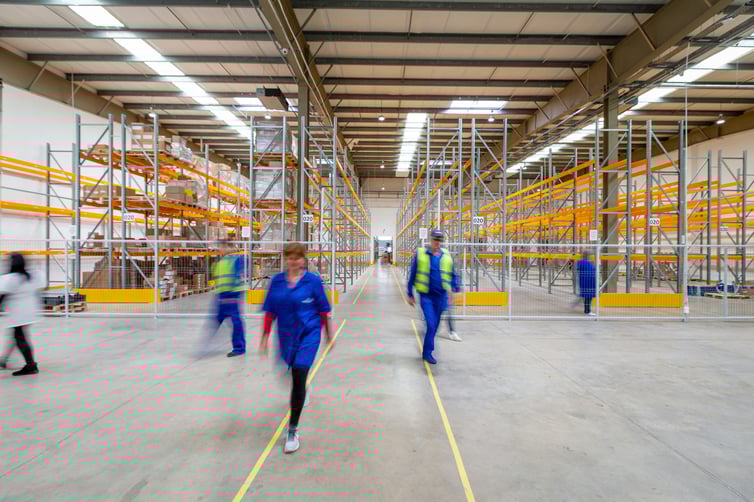
Consider the pedestrian standing at an unmarked junction, watching a counterbalance FLT approaching from the left. Does the driver see them? Is this a shared zone or a vehicle-only route? Who has priority?
That half-second of hesitation, where the person is processing ambiguous information and deciding whether to move or wait, is where a significant proportion of near-misses and incidents occur.
Hesitation is the result of environmental ambiguity. When the physical cues available in a space give conflicting or insufficient information, the brain pauses to gather more data. In a warehouse, there is often no time for that pause to resolve safely.
Physical segregation (barriers, gates, defined crossing points) removes ambiguity because it removes the choice. The pedestrian knows exactly where they can go, and so does the driver. There is no negotiation at the junction, no eye contact protocol, no reliance on two people making the same correct decision simultaneously.
Environments that rely on rules rather than physical controls put the burden of correct behaviour on people operating under pressure, distraction, and habit. That's a design flaw, not a training gap.
If you're reviewing crossing points and shared zones on your site, our guide to barrier placement by zone covers where physical controls make the most difference.
What Do Movement Patterns Tell Us About Warehouse Layout?
Most warehouse layouts are designed with a traffic flow model, an intended pattern of how vehicles and people will move through the space. That model is typically drawn up during the fit-out or expansion planning stage, and it reflects rational, ideal-case routing.
What it rarely reflects is how the layout will actually be used six months into operation, when shortcuts become habits, when racking configurations shift, when seasonal demand changes traffic volume at specific points, and when new starters copy what they see from experienced colleagues rather than what the induction training showed them.
Real movement patterns reveal a different map. They show where pedestrians accumulate, where vehicle and pedestrian routes converge, where sightlines are compromised, and where the highest-frequency interactions between people and moving vehicles occur.
PAS 13:2017, the code of practice for safety barriers used in traffic management within workplace environments, is clear that barrier placement should be based on the actual risk, including the behaviour of the people in the space, rather than just the theoretical routing plan. Barriers placed according to a design-stage layout model rather than observed traffic behaviour often protect the wrong areas.
A site that hasn't been physically re-assessed since its original barrier installation may look compliant on paper while the real risk has moved.
What Makes a Visual Cue Effective?
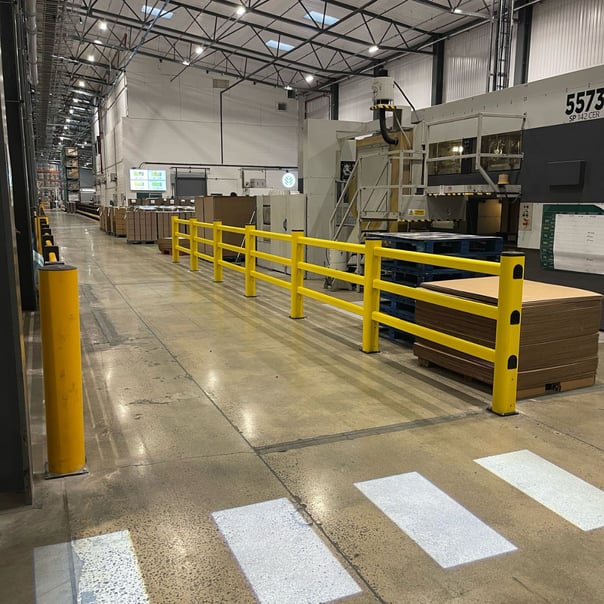
Not all visual safety cues are equal, and the difference between those that change behaviour and those that get ignored comes down to a few consistent factors.
Contextual Relevance
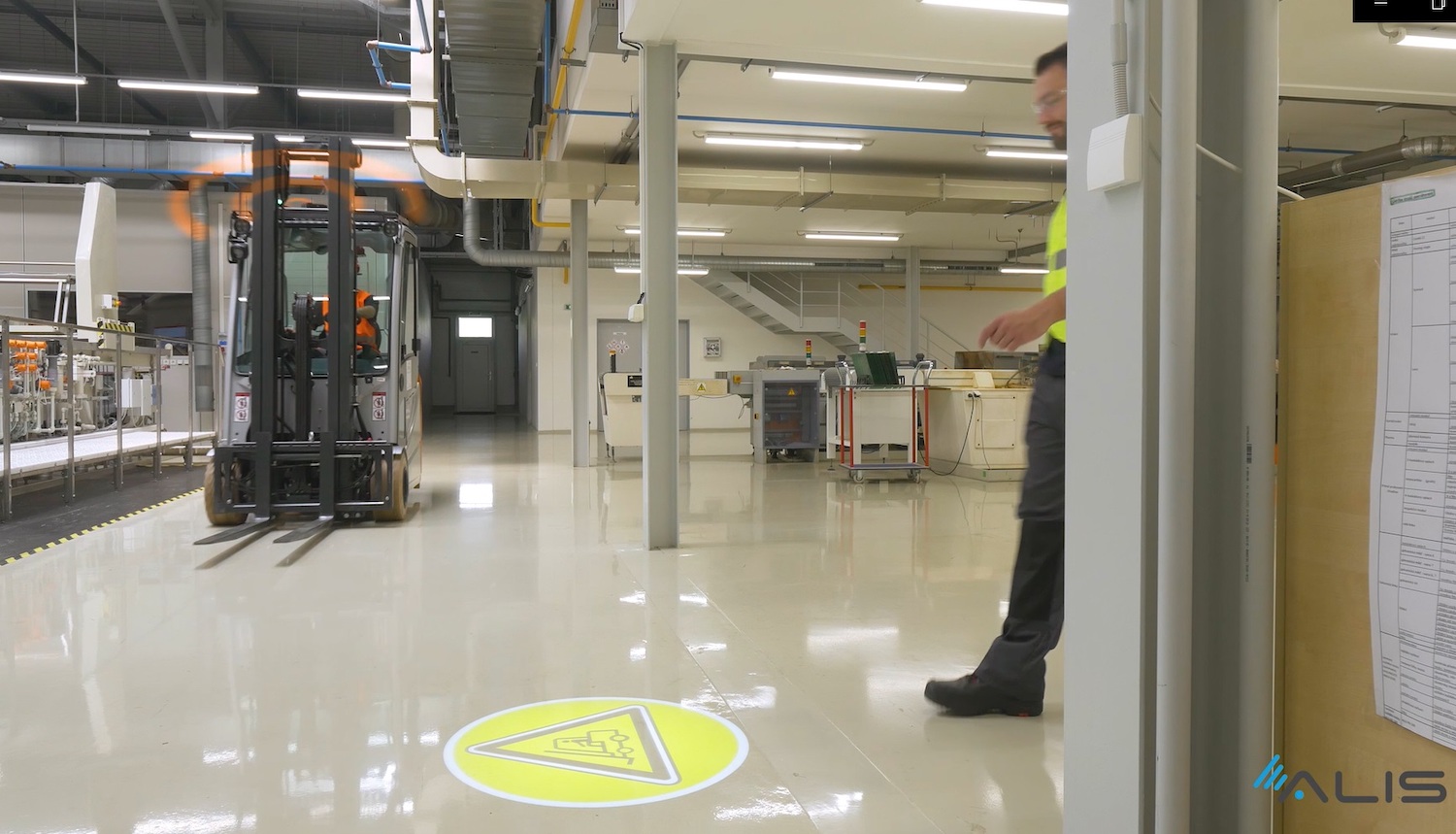
A cue is effective when it appears at the point of decision, not before it. A sign on the wall six metres before a crossing point requires the walker to hold that information in working memory until they reach the risk. A cue that activates at the exact point of crossing (like an LED-projected walkway that illuminates when a vehicle is nearby) requires no memory retention. The information is present when it is needed.
Dynamic vs. Static
Static cues are habituated quickly. Dynamic cues, those that change state, activate on trigger, or vary in some way, retain salience for longer because they are not processed as background. Movement, light change, and colour contrast all interrupt the brain's filtering of familiar stimuli.
Physical vs. Informational
A barrier that physically prevents a person from entering a hazardous zone is more reliable than a sign telling them not to. Physical controls do not depend on the person reading, processing, and choosing to comply. They remove the compliance step from the equation entirely.
This is why our LED projected floor markings are gaining traction in sites where painted lines have failed. Unlike floor paint, LED projections don't fade, can't be obscured by pallets, and can be configured to respond to the presence of vehicles or pedestrians making them contextual and dynamic rather than static and passive.
For a deeper look at why static markings lose their effectiveness over time, read our article on why your workers can't see the safety signs right in front of them.
How Do You Design a Warehouse That Works With Human Behaviour?
The short answer: treat behavioural compliance as an outcome of design, rather than a requirement placed on individuals.
The environments with the lowest incident rates are not necessarily the ones with the most signage or the most training hours. They're the ones where the physical layout, the visual systems, and the control measures collectively make the safest route the easiest route - where doing things correctly requires no additional effort, and doing things incorrectly is physically difficult.
In practice, that means a few things:
- Observe before you install. Map where people actually go, not where they're supposed to go. Near-miss data and direct observation of traffic patterns will tell you more about real risk than any floor plan.
- Eliminate ambiguous zones. Every point where a vehicle and a pedestrian might be uncertain about priority is a point where hesitation (and incident risk) is built into the environment. Physical segregation removes the uncertainty.
- Replace static cues with dynamic ones. Painted lines and wall-mounted signs have a role, but they degrade and they habituate. Invest in cues that remain salient under real working conditions.
- Review after every significant operational change. A layout that was safe at the point of fit-out may have accumulated new risk through racking changes, staffing growth, or process evolution. Behaviour adapts faster than layouts.
At Clarity, we work with warehouse operations across the UK to identify the gap between how a site was designed and how it is actually being used. Our on-site assessments look at real movement patterns, not just barrier compliance, and we design segregation systems that account for how people behave under operational pressure.
If you want to see what a behavioural lens applied to your site might reveal, book an on-site assessment and we'll walk the floor with you.

.jpg)